MersivFacing the challenge of learning to speak like a local without traveling, we developed Mersiv—an app that provides immersive language experiences within your own community.
This project was completed over 10 weeks as part of CS 147: Human-Computer Interaction. We won the Most Novel Award.
In this section, I will go over our approach to designing Mersiv.
Needfinding
〰️
Needfinding 〰️



I interviewed a sample of different of language learners (polyglots, immigrants, linguistic enthusiasts) and created Empathy Maps (left) to reflect on the insights found. We discovered that to master a language, you need to interact with the culture and indulge in colloquial conversation—written language practice isn’t enough.
Problem: Language learners lack access to local and affordable opportunities for in person intercultural exchanges.
Solution: Mersiv connects learners with local language hosts who provide immersive cultural and educational experiences.
Experience Prototypes
〰️
Experience Prototypes 〰️

At this stage, my team and I tested our findings and assumptions by conducting live-prototypes. To the right, we tested users’ willingness to engage in cultural experiences.
The result? Our users left feeling motivated and fulfilled.
Low-Fidelity Prototype
〰️
Low-Fidelity Prototype 〰️

Here, I co-created a series of screen sketches that modeled the simple, moderate and complex task flows of our language learning app. We tested this prototype with real users for efficiency and robustness.
Medium-Fidelity Prototype
〰️
Medium-Fidelity Prototype 〰️

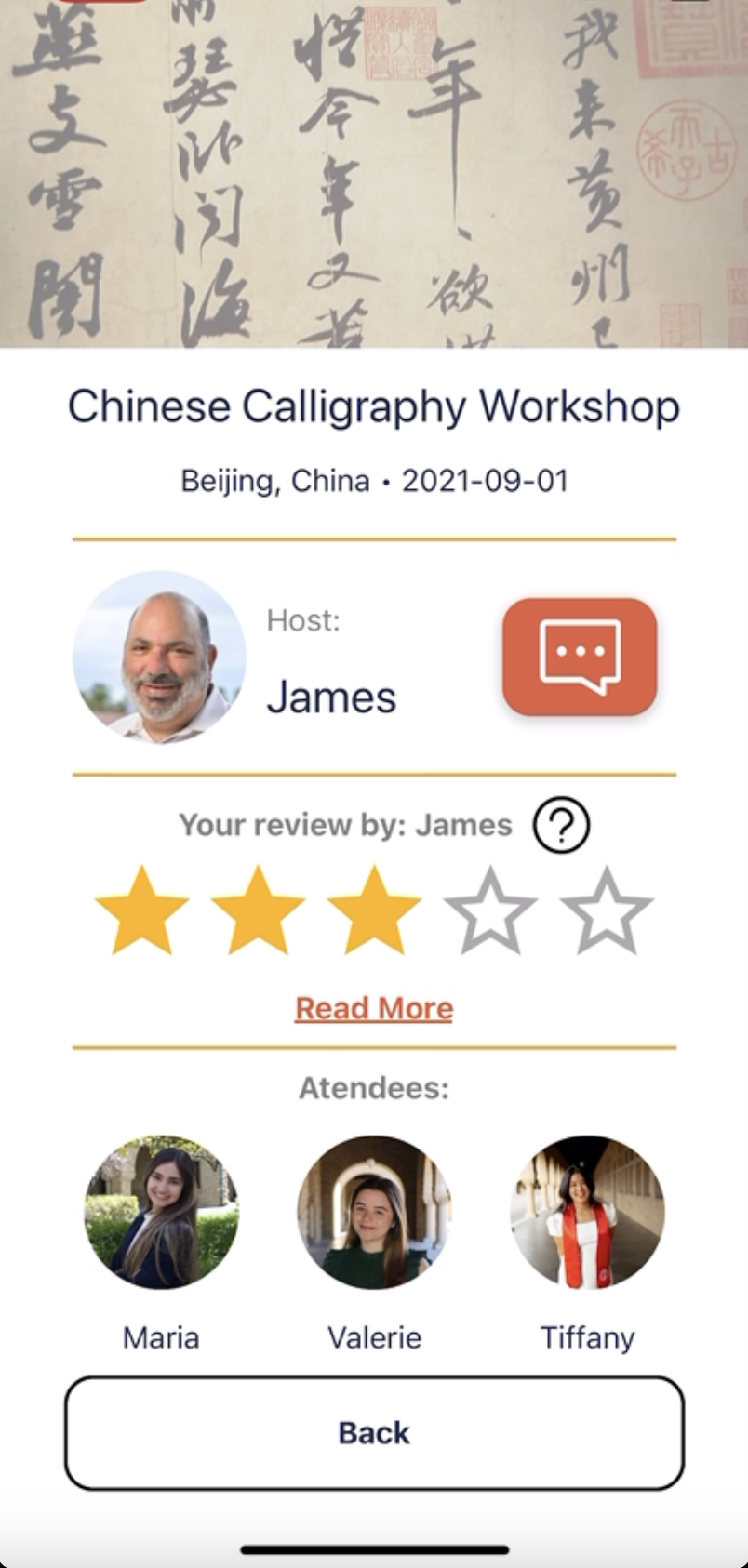
Using Figma, I co-created a prototype of the task flows. We designed a home screen, a discover page, chat functionality, and a history page. We tested this prototype by conducting a heuristic evaluation, through which we discovered gaps in the task flow, inefficiencies, and color clashes.
High-Fidelity Prototype
〰️
High-Fidelity Prototype 〰️


